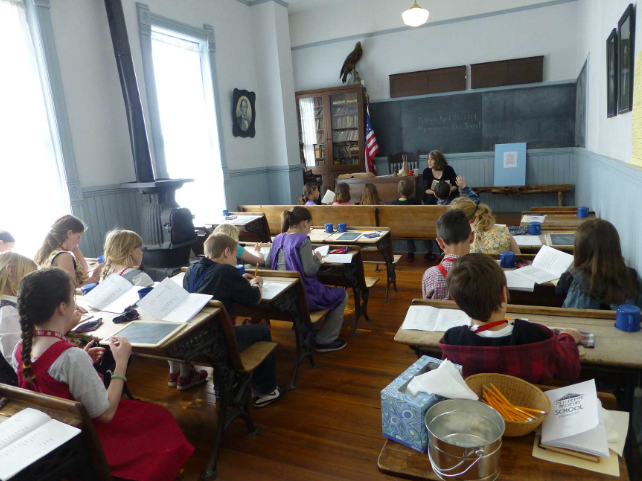
Saint Mary’s fourth graders stepped back in time this week during their annual Heritage Field Trip, a signature part of the school’s Nebraska history curriculum. The day‑long excursion took students to the State Historical Museum, the Pioneer Village outdoor exhibit, and the Immigrant Experience Center, offering a hands‑on look at the people and cultures that shaped the region.
Fourth‑grade teacher Mrs. Karen Schultz said the trip is one of the most meaningful learning experiences of the year.
“Students read about pioneers and early settlers, but seeing the artifacts in person — the tools, the clothing, the wagons — helps them understand the challenges and resilience of the people who came before us.”
Students began the morning at the State Historical Museum, where docents guided them through exhibits on Native American tribes, early homesteaders, and the development of Nebraska’s agricultural communities. Each student carried a scavenger‑hunt booklet, encouraging them to locate specific artifacts such as a buffalo hide, a sod‑cutter blade, and a hand‑stitched quilt.
Nine‑year‑old Lily Hernandez said the sod house replica made the biggest impression.
“It was so small,” she said. “I can’t imagine a whole family living in one room. And it smelled like dirt — but in a good way.”
Classmate Jacob Miller was fascinated by the blacksmith demonstration.
“The man showed us how they heated metal until it was red,” he said. “He said kids my age used to help pump the bellows. I’m glad we don’t have to do that now.”
After lunch, the group visited the Immigrant Experience Center, where students learned about the waves of European, Asian, and Latin American families who settled in the Midwest. Volunteers dressed in period clothing shared stories of long journeys, language barriers, and the importance of faith communities.
Parent chaperone Maria Thompson said the center helped students connect their own family histories to the broader story of Nebraska.
“Many of our students have grandparents or great‑grandparents who immigrated here,” she said. “It’s powerful for them to see that their families are part of the state’s history.”
The day concluded with a short prayer service led by Deacon James in the museum courtyard. Students offered prayers of gratitude for their ancestors, for the land they live on, and for the opportunity to learn from the past.
Mrs. Schultz said the trip always sparks meaningful classroom discussions.
“When we return, students talk about how hard life was, but also how communities supported each other,” she said. “They start to understand that heritage isn’t just about objects — it’s about people, sacrifice, and faith.”
As the buses pulled back into the Saint Mary’s parking lot, students carried journals filled with sketches, notes, and reflections. For many, the trip was more than a school outing — it was a chance to see themselves as part of a larger story.